Meet the Residents: Journalism Goes to School.
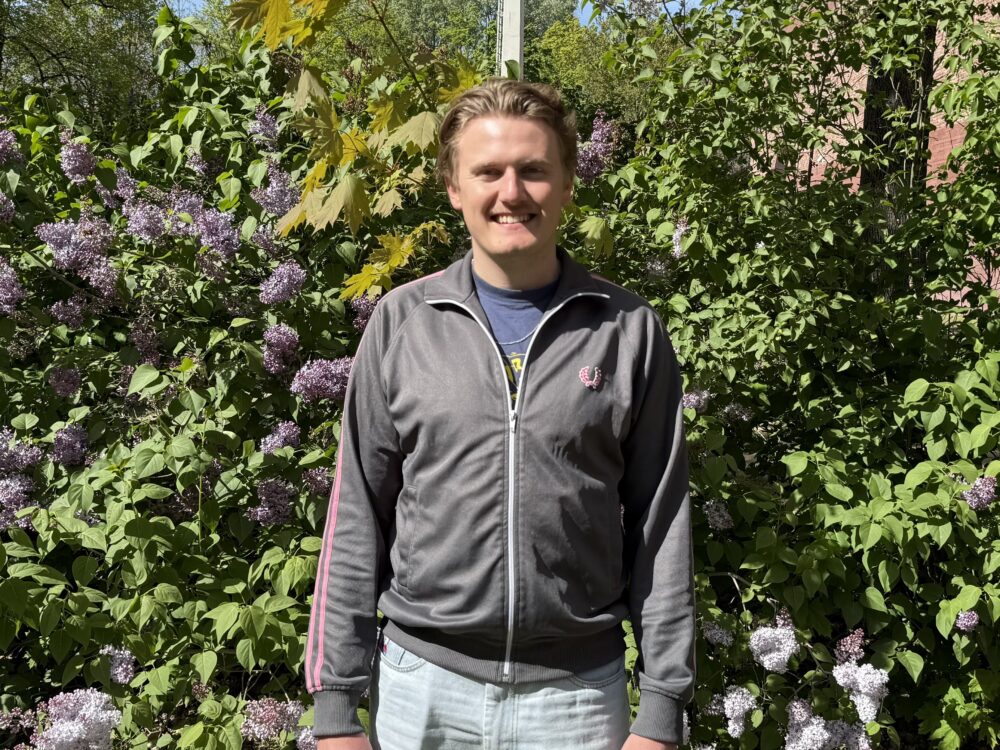
Each issue of our newsletter features a person or organisation working out of the Publix building. This time: Julian Ungerer, Project Officer at Journalism Goes to School.
What is at the heart of your work?
Our focus is on news literacy and media competence among young people. "Journalism Goes to School" (Journalismus macht Schule) is a nationwide network that connects existing initiatives and stakeholders, and supports joint projects. A central element is placing journalists in schools to lead classroom discussions – explaining to pupils, for instance, how news is produced, how to identify disinformation and manipulation, and why a free press matters. We also offer continuing professional development for journalists and teachers alike.
What cause are you championing?
We want to tackle the growing news fatigue amongst younger audiences. We firmly believe that news literacy is a form of democratic literacy, and we are actively advocating for it to be embedded as a permanent fixture in the school curriculum. Pupils should come away knowing how to inform themselves about current affairs as comprehensively, impartially, and accurately as possible. There are already many excellent initiatives and organisations working to strengthen information and news literacy in education. What is missing is a coherent strategy and coordination of all actors and activities at both state and federal level, along with the integration of these efforts into official curricula and public structures. That is precisely where we come in.
Where is your focus at the moment?
The 3rd of May is World Press Freedom Day. Under the banner #PressefreiheitMachtSchule – Press Freedom Goes to School – we are organising a range of events and activities across the country. We are, for example, intensifying our school visits, including appearances by prominent journalists such as Giovanni di Lorenzo, Ingo Zamperoni, Eva Schulz, Sandra Maischberger, Georg Mascolo, and Dunja Hayali. We are also coordinating several activities and programmes for pupils together with our members and regional partners, including those in Rhineland-Palatinate, Central Germany, and Lower Saxony. In Berlin, we will have a stand at the Publix Newscamp Neukölln, and on the evening of 6th May we are inviting all interested parties to a panel discussion at Publix.
What keeps you up at night?
One of our greatest challenges is precarious funding – a problem that affects the vast majority of NGOs, of course. We are working towards greater long-term financial independence, for instance by developing a supporting membership scheme, so that we can stand more firmly on our own feet. At the same time, writing grant applications is enormously time-consuming and absorbs resources that we then lack for our core work. It is, unfortunately, a game of ping-pong: everyone agrees the issue is critically important, yet education policy consistently lags behind. We find ourselves playing the role of the fire brigade, putting out blazes – but closing the gaps that genuinely exist requires sustained funding, and that funding either does not materialise, or arrives only very, very slowly. Beyond the educational work we carry out, there is also a broader need for the subject to be made a compulsory element of teacher training and professional development. And when it comes to social media, the distinction between fact and opinion, and artificial intelligence, regulation is essential too. Schools cannot be expected to compensate for everything indefinitely – the field is moving far too swiftly and dynamically for that.
What has been your greatest success in recent months?
We have launched our new matching platform. It replaces what was previously a laborious process involving a booking portal and spreadsheets with a far more efficient solution: journalists register directly through a dedicated portal, teachers submit requests, and suitable matches are made automatically. The results speak for themselves: we have significantly more registered journalists volunteering with us than in previous years, and the number of facilitated school visits rose sharply in the first quarter.
A publishing project that has caught your eye?
I think the format of FunFacts is brilliant. It really challenges the cliché that journalism is often po-faced or somewhat elitist. They make extensive use of satire and humour, which allows them to connect with people who might not have an academic background – bringing journalism closer to those who might otherwise feel it is not for them.
What would you recommend reading to understand the current moment?
I am drawn to historical texts, because they so often reveal patterns that remain relevant today. Thomas Mann's Deutsche Hörer (German Listeners) has made a particular impression on me: during the Nazi era, he broadcast radio addresses to Germany from exile in the United States. Transcribed some years ago, they contain striking parallels between the political promises of that period and developments we are witnessing today.
What should people be looking into right now?
Given how unsettled so many people feel at the moment, I would simply point people towards our policy paper, "Fighting Disinformation: How School Systems Around the World Teach News Literacy" – available at journalismus-macht-schule.org.