Meet the residents: Media Forward Fund
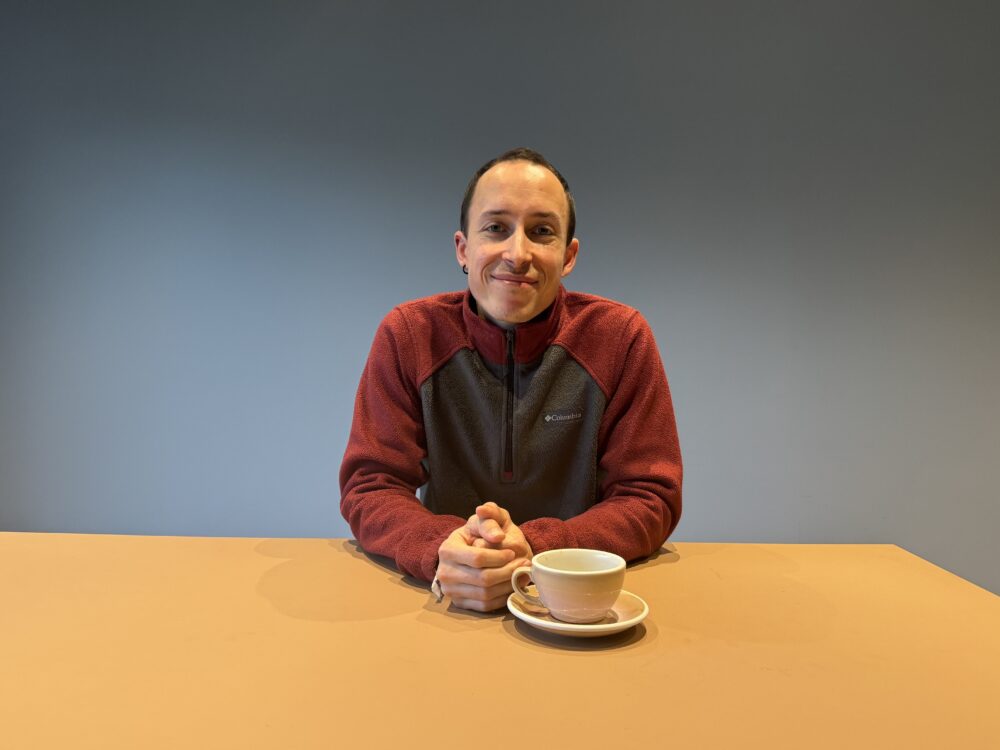
In every newsletter, we talk to Publix residents about their work and current media policy issues. This time: Jascha Galaski from Media Forward Fund.
What do you do, and how do you do it differently from others?
We are a philanthropic collaboration: around 20 foundations pool their funds into a joint fund. We use this to support public-interest journalism in the DACH region through open calls for proposals. Our focus is on sustainable business models: we want media organisations to be self-sufficient in the long term. To this end, we work very closely with them to help them implement their projects.
What are you working on?
I’ve been part of the funding team for a year and a half. We manage the calls for proposals and the selection process for the funding programmes, and support our partners throughout the funding period.
You refer to your programmes as ‘funding streams’. People can apply for a ‘Launch Grant’ or a ‘Growth Grant’. What are these?
We generally prioritise high journalistic standards, editorial independence and a sustainable business model. Through a ‘Launch Grant’, we support organisations in bringing their projects to market. In September, we launched our first regional funding programme in French-speaking Switzerland: with up to CHF 125,000, organisations can bring their idea to market within a year and achieve a “proof of concept” as well as “product-market fit”. This means that the project exists and there is a market for it – for example, subscribers who are already paying. A ‘Growth Grant’ is aimed at organisations that already have a successful product and want to scale up their business model. It runs for two years and provides funding of up to 400,000 Euros. We want to highlight what works so that other organisations can learn from it. We also launched ‘Strategy Grants’ for the first time in September.
What is your application process like?
The application process takes place in several stages. First, organisations submit a brief introduction. We then hold an initial interview with selected organisations, followed by the submission of a detailed application. In the next step, we examine the organisations more closely as part of a ‘due diligence’ process. Finally, the organisations pitch their ideas to our jury, which makes its decision independently of the funders.
What happens after the grant is awarded?
Once the grant has been awarded, the project can begin. We start with an ‘onboarding’ process. The organisation then implements its project in line with the milestones set out in its application. For a ‘Growth Grant’, this runs for two years; for a ‘Launch Grant’, it runs for one year. During this time, we monitor progress together.
What do the media need most urgently?
Funding is important, but so is support. That’s why, alongside the funding, we offer an ‘upskilling’ programme with various formats, such as ‘Deep Dives’ and ‘Learning Visits’. We also hold regular ‘check-ins’ where we review the milestones together and, where necessary, connect organisations with coaches or suitable partner organisations.
What concerns you?
When it comes to AI, I’m struck by just how quickly everything is developing at the moment and how much we all still need to adapt to it. AI is cropping up more and more frequently in applications, so far mainly in operational contexts – for example, in data collection, translation or proofreading. It’s mentioned less often in relation to journalistic work itself. However, some of the projects we fund are already working with it.
Which journalism project has impressed you most recently?
The Palantir investigation by the WAV collective from Switzerland: they’re taking on Palantir and have been sued by Palantir as a result. They’re a strong team doing a brilliant job.
Where can people follow your work?
You can find us on LinkedIn and on our website, and you can subscribe to our newsletter. We also attend lots of conferences and organise our own events. The next big event is the ‘Deep Dive’ in Zurich in early November. In January, the jury will then make its decision on the current funding round.