The AI Hype Is Not A Niche Topic
Do we still need libraries? Artificial intelligence is a threat both to places of knowledge transfer as well as to the future of democratic participation. Yet resistance is emerging.

I’m surrounded by one and a half million books: knowledge from every conceivable discipline, stories from all over the world. I’m sitting in Amsterdam’s OBA, one of the largest public libraries in Europe. An impressive building, it was designed to provide free access to knowledge, but do we really need places like this when everything is apparently available online? If the major AI companies have their way, we won’t be turning to libraries for world knowledge much longer, we’ll all be using chat interfaces.
Of course, you shouldn’t believe everything you hear. In January, I began an event series with my organisation, SUPERRR, to challenge some of the myths around artificial intelligence. AI: Power, Myths, Misunderstandings has already brought together more than 500 people to speak about digital power structures and a future worth living for: school pupils and pensioners, teachers and entrepreneurs, sceptics and enthusiasts. We decided to go into libraries, with a view to reaching people of all ages and levels of prior knowledge.
We were warned that critical engagement with AI would be too complex for anyone outside of tech policy. Yet the specialist audiences and decision makers to whom our consultation programs were previously catered had long since become disillusioned. For years, new European regulations are negotiated, only to be watered down, and ultimately sacrificed to the economic and political threats of the United States. I am now convinced that if the political process is so fragile and so susceptible to lobbying and power games, then the change will have to take shape somewhere else. It won’t be in the conference rooms of Washington, Brussels, and Silicon Valley, but in local districts, neighbourhoods – and libraries.
Europe has 68,000 public libraries. In our increasingly fragmented societies, they are among the few places still accessible to everyone. They host readings and exhibitions, coding courses, language workshops, theatre performances, and public debates. People come together to read, exchange, or simply to spend time with one another. Libraries are the social infrastructure for learning, for encounters, and for democratic participation, exactly the arenas that artificial intelligence is putting under strain.
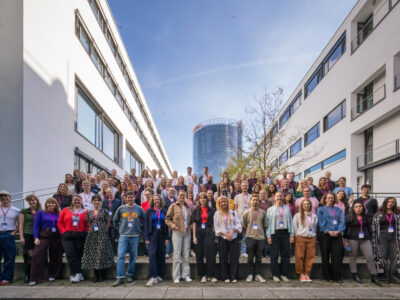
At the OBA in Amsterdam, I find myself surrounded by hundreds of librarians who have travelled here for a conference as part of the European Cultural Foundation’s “Libraries for Europe” programme. The focus is on the future of their institutions. Our SUPERRR event on AI myths has struck a chord, and the room is packed. Ultimately, no one wants to miss the boat or to be among those who sleep their way into the future.
We begin by interrogating some familiar narratives – “AI will take your jobs”, “AI is the future”, “AI cannot be stopped” – before quickly turning to the ecological footprint of large language models. The topic is very relevant here given that Amsterdam is home to one of the biggest internet hubs in the world. Yet with network capacity already stretched, approval for new infrastructure is not generally given. Why, then, is an enormous private data centre, a so-called hyperscaler, currently under construction in the west of the city? Experts are pointing to the use of legal loopholes.
Speaking at our event, Dutch academic Corinne Cath put the scale of the data centre into perspective, explaining that it could end up consuming as much electricity as the whole of Amsterdam. Indeed, should the Hyperscaler join the grid, capacity for the construction of ten thousand new homes and public buildings would disappear. Amsterdam thus exemplifies what can happen when private infrastructure takes precedence over public infrastructure. If the common good is no longer a priority, everyone will be affected by the consequences of the AI hype.
Resistance is mounting, however, and of all places in the USA, the heartland of the AI giants. While investment in AI is at an all-time high and new data centres are appearing all over the country, public opposition is on the rise. People are pushing back against the water shortages, air pollution, rising land prices, and power outages. And they’re having an impact. In 2025 alone, projects worth more than $60 billion were halted or delayed within the space of a few months, and not by regulatory authorities or expert committees but by local initiatives. People from across the political spectrum are joining forces and fighting for a common cause.
The AI hype is not going to fade anytime soon. Billions more will be invested, and grand promises will be made. But as long as there are places where people can come together and discuss these developments, where dissent can form, the future will not be exclusively decided upon by corporations and experts. The future is not a niche topic. It is a democratic responsibility. Indeed, the most important question when it comes to artificial intelligence is not technological: what kind of society do we want to live in? If we want a future built on knowledge, exchange and participation, then libraries – as hubs of democracy – are indispensable.
Julia Kloiber is a digital policy expert and founder of SUPERRR Lab, a feminist organisation based at Publix in Berlin. She advises public-sector institutions and non-profit organisations on digital strategy.
Translation: Michael Dorrity
Photo credit: Marlene Burz