Meet the residents: The Conversation
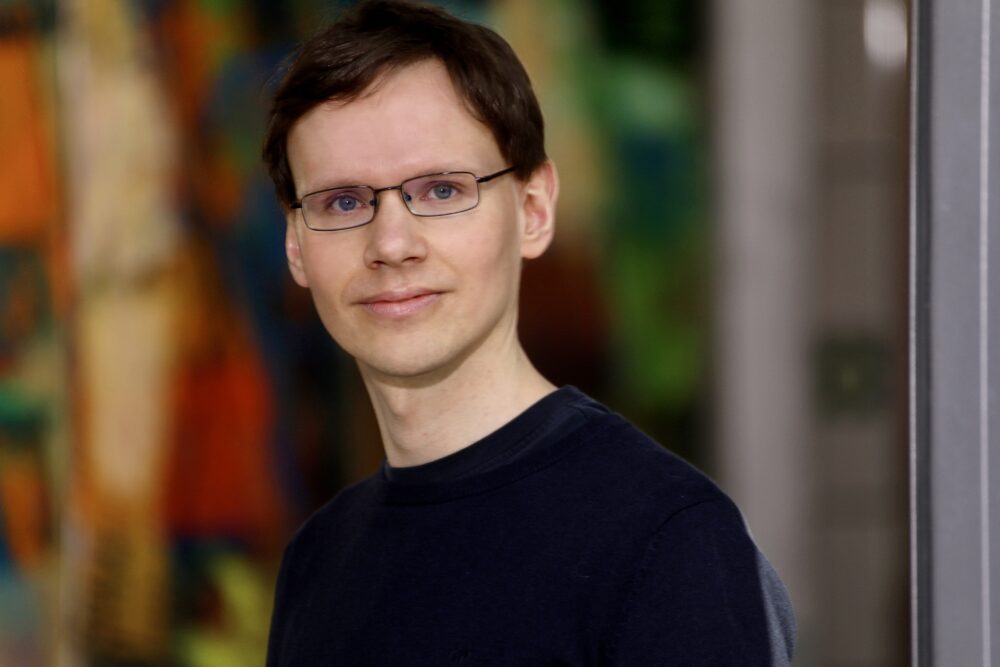
In each edition of our newsletter, we introduce one of the organisations based at the Publix House. This time: Robin Markwica, Managing Director of the online magazine “The Conversation”, which will launch in Germany, Austria and Switzerland in 2026.
What is the core of your work?
Surveys show that a large majority of the population would like science to share its knowledge more actively with the public. That is why we are currently establishing editions of the international online magazine The Conversation (TC) in Germany, Austria and Switzerland.
At TC, researchers from all disciplines analyse current affairs and report on relevant new research findings. An independent journalistic editorial team selects and fact-checks the articles and supports researchers in presenting their work in a way that is as accessible as possible. Our topics range from politics, society and the economy to health, nutrition, technology, climate and the environment, as well as education, art and literature.
TC is permanently non-profit and non-partisan. Since its founding in Australia in 2011, we have launched editorial teams in twelve additional countries – Brazil, France, Ghana, the United Kingdom, Indonesia, Canada, Kenya, New Zealand, Nigeria, Spain, South Africa and the United States. To date, almost 100,000 researchers worldwide have published with us.
Our content is freely accessible, meaning it can also be read by people who cannot (or no longer can) afford a newspaper subscription. As a result, we reach an average of 40 million people worldwide every month. We plan to go live in Germany, Austria and Switzerland by autumn 2026.
What is the goal of your work?
For years, surveys have shown that people in Germany trust science significantly more than the media – and even more than politics. This represents a major opportunity for TC. With the help of contributing researchers in Germany, Austria, Switzerland and around the world, we aim to provide reliable information based on the latest state of research. Our goal is to offer fact-based answers to the most pressing political, social, economic, ecological and ethical questions of our time.
We also hope that the scientific expertise published on TC will help drive innovation in society. That is why we will translate the most relevant articles from our international network into German.
What are you focusing on at the moment?
The launch of a new TC edition always follows the same principle: an alliance of foundations provides initial seed funding. In the United States, for example, we have been supported by the Ford Foundation, the Knight Foundation and the MacArthur Foundation, among others. After that, universities and research institutes collectively take over long-term funding.
As Managing Director, I am currently focused on building a funding alliance of 10–12 foundations, as well as a group of around 20 cooperating academic institutions in Germany, Austria and Switzerland.
What has been your biggest success in recent months?
I am very pleased that the Gebert Rüf Foundation, the Volkart Foundation, the Fondation Aventinus, the Else Kröner-Fresenius Foundation, the Gemeinnützige Hertie-Stiftung, the Avenira Foundation and the ZEIT STIFTUNG BUCERIUS have already agreed to support us. This secures part of the necessary start-up funding, though there is still much work to be done.
We have also made progress in assembling our network of partner institutions. In Germany, interest has been expressed by the universities of Erlangen–Nuremberg, Hamburg, Rostock and Tübingen; the Technical Universities of Dresden and Munich; Bucerius Law School; as well as institutes from the Leibniz Association and the Max Planck Society. In Austria, partners include the University of Innsbruck, the Medical University of Vienna, TU Wien, the Austrian Academy of Sciences, Central European University and the University of Vienna. In Switzerland, alongside EPFL Lausanne and ETH Zurich, the universities of Basel, Bern, Geneva and Zurich are involved.
What’s giving you headaches?
At the international level, we should be prepared for the Trump administration attempting to annex Greenland and launching attacks on Iran and Cuba. In Germany, we must be prepared for the AfD to become part of state governments in the foreseeable future – or even to lead them.
In light of these developments, it is time to redefine what we mean by a democratic, sovereign and solidaristic Europe – explicitly not only in terms of security policy, but also from a civil-society, economic-technological and philosophical-cultural perspective.
What is your contribution to a plural media landscape?
TC will be the first non-profit online magazine in Germany, Austria and Switzerland in which researchers from all academic disciplines – from the DACH region and beyond – make their expertise available free of charge.
Because our articles are published under a Creative Commons licence, other media outlets can republish them at no cost. Every week, hundreds of newspapers worldwide – including the BBC, The Guardian, CNN, The Washington Post and El País – take advantage of this opportunity. I hope that the diversity of perspectives on TC will also enrich the media landscape in German-speaking countries.
Which journalistic project has impressed you most recently?
With support from the Innovation Fund for Multimedia Journalism, the Swiss online magazine Republik asked seven researchers from different disciplines to propose solutions to the climate crisis. The result is a video series full of valuable insights – for example, on how findings from atmospheric physics could help protect the Great Barrier Reef off Australia’s northern coast, or how corporations and governments that neglect climate protection can be held legally accountable.
Who or what deserves much more attention?
When German media interview scientists, they usually speak to established professors. Yet it is often early-career researchers who are making the most exciting discoveries – in laboratories, archives or through field research.
As members of Generations Y and Z, they bring different perspectives on society and often develop innovative solutions. They tend to use social media intuitively and understand the needs of their peers. In my view, the knowledge and expertise of these young researchers deserve far more attention.
What’s the best reading on the current situation?
In her new book States of Solidarity: How to Build a Society (Oxford University Press, 2026), political scientist Barbara Prainsack makes a compelling case that solidarity is a central pillar of a democratic, just and sustainable future. She analyses the role of solidarity through three case studies: the climate crisis, the future of work and digital transformation through AI. She shows how solidarity can become a creative force and strengthen social cohesion in all three areas.
What should people listen to or watch right now?
During my years in the UK, I grew very fond of The Guardian’s daily podcast Today in Focus. And of course, I also recommend The Conversation Weekly, which was recently named Podcast Publisher of the Year 2025.
Mehr über The Conversation
Photo credit: Vincent Leifer