What exactly is broken?
The media sector, as a pillar of democracy, has become fragile. To repair it, we need a clear definition of its remit. The first Publix white paper provides one.
By Maria Exner, Director of Publix
If a doctor wants to help a patient, she needs to know three things. Two of which are obvious: she needs to be able to diagnose the problem and have promising methods to treat it with. The third point is easy to overlook: she needs to know what a healthy person looks like. What levels are normal? How does a healthy person move? What do they look like? If the definition of “healthy” is missing or poorly formulated, there can be neither accurate test results nor appropriate therapy.
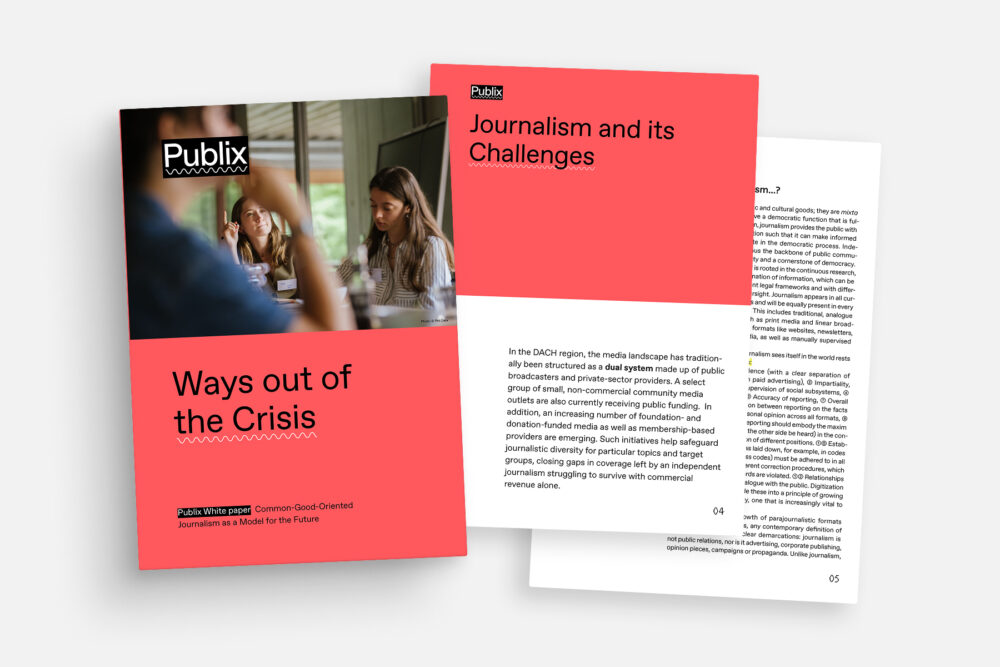
When it comes to the development of the information and media sector, we do not talk about an illness (unless we’re a populist seeking to diagnose society with some “cancer” or other) but about a crisis. The metaphor may be an oversimplification, but it nonetheless helps give you an idea of why I teamed up with the Austrian political scientist and media scholar, Andy Kaltenbrunner, to put together a white paper titled “Ways out of the Media Crisis: Common-Good–Oriented Journalism as a Model for the Future”. The paper offers a concise proposal toward a definition of the term common-good-oriented journalism.
After all, what goals are we’re working towards here at Publix, the new home for journalism and the public sphere? What improvements do we want to make together with those in universities, foundations, think tanks, and NGOs, with those in politics and the media itself, as well as with regular individuals? What improvements should we seek with everyone who is concerned by the targeted manipulation of public opinion, the loss of social participation, the disappearance of local newspapers or at least of local content, the shift to the right, and the fact that problems are no longer presented in the media to find a solution but instead to discredit democracy?
Even for myself, as director of Publix, the goal has not always been completely clear. This is how the white paper – “Ways out of the Media Crisis” – came about. It is the product of close collaboration with eight foundations from Switzerland, Austria, and Germany. With the funding they provide and as partners of the Media Forward Fun, they already make a significant contribution to maintaining media diversity and supporting journalism in its crucial task of providing accessible and educative information.
In interviews with professionals and in light of the current state of media research, one thing has become clear: as a democratic force, journalism should be understood as a choir composed of many voices. Each member acts independently and of their own accord, yet they all hold to a shared and binding code of conduct. (This is not, in the end, so different to the doctor, who is guided by the Hippocratic oath.)
The white paper argues that when a society’s information space and its public debates are made up by a multitude of common-good-oriented media companies, the crisis will have been overcome. From here on in, we can walk that path there together. Our white paper invites everyone to build on it in their own sphere of action. As of now, the goal has been clearly laid out.
The white paper “Ways Out of the Media Crisis” resulted from a collaboration with the ERSTE Foundation, Mercator Foundation Switzerland, the Volkart Foundation, ZEIT STIFTUNG BUCERIUS, the Rudolf Augstein Foundation, Allianz Foundation, the Schöpflin Foundation, and Stiftung Medienvielfalt Basel.